
This essay is a forensic clarification, not a foundational metaphysical argument and not a prescriptive rhetoric manual. It presupposes an externally grounded account of truth and correctness, in which propositions succeed or fail by correspondence to constraint-bearing realities, and standards of correctness are not generated by coherence, consensus, or linguistic refinement. That grounding has been established elsewhere and is not defended here.
The present task is narrower: to describe how access to agency, causation, and responsibility progressively degrades downstream, even while ontology itself remains unchanged. This analysis therefore concerns loss of access, not loss of truth.
It is essential to state at the outset that isolating structural mechanisms does not deny moral agency or culpability where agency is present. Rather, the analysis identifies how agency and process can become linguistically and semantically unrecoverable even in the absence of deception or bad faith.
Accordingly, this essay sits adjacent to, but does not compete with:
Ontology remains non-instrumental and prior. OCBM and RSD are diagnostic substrates that must themselves be interrogated. By contrast, semantic cartography and radial decay are forensic mapping tools: they locate where reconstructability has degraded without adjudicating legitimacy, correctness, or boundary violation.
This essay therefore maps loss, rather than judging it.
This analysis presupposes an externally grounded account of truth that remains structurally recoverable within the discourse under examination. Where such grounding is suppressed through ellipsis—such that the source of truth, normativity, or constraint is no longer recoverable—radial analysis does not apply in the same way. In such cases, the problem is not progressive loss of causal recoverability, but prior detachment from ontological anchoring. The present framework therefore operates only where grounding, whether explicit or implicit, remains in principle recoverable.
Across ethics, law, institutional discourse, and public reasoning, a recurrent pattern is evident:
This pattern is often attributed to moral failure, manipulation, or strategic obfuscation. While such factors may occur, they are not required to produce the phenomenon under examination here.
The central claim of this essay is more austere:
Much downstream distortion arises structurally, independent of intent, through the progressive separation of agency from process and outcome.
What is lost is not reality, nor truth, but causal recoverability. Effects remain observable, yet the information required to re-bind those effects to enacted agency through traceable process is no longer retained.
This loss of recoverability produces a distinctive illusion: discourse continues to feel explanatory even as explanation has become impossible. Outcomes anchor discussion, but genealogy has collapsed. That illusion—rather than moral failure as such—is the primary object of analysis.
To describe this phenomenon, we introduce the notion of radial distance.
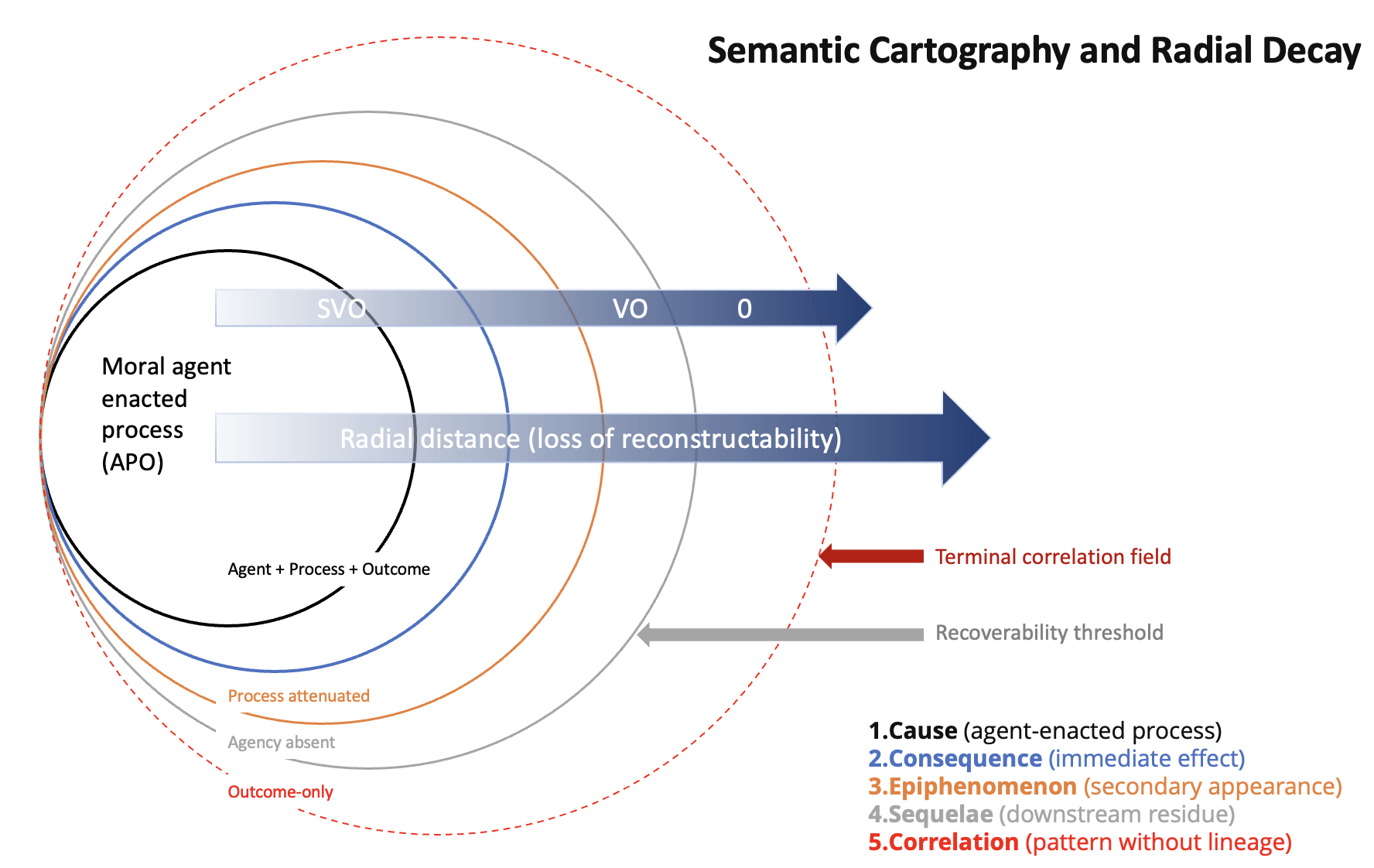
Radial distance is not temporal, psychological, or intentional. It denotes distance from the point at which agency, process, and outcome remain coupled and reconstructable. Movement outward along this axis preserves observable effects while progressively dissolving access to their origins.
A minimal radial progression may be expressed as:
Radial distance does not imply error, deceit, or falsehood. It tracks semantic thinning: the loss of structural information required to recover causal linkage.
Semantic cartography is the act of locating discourse within this radial field. It does not interrogate claims, enforce boundaries, or assign fault. It answers one question only:
How far has agency and process drifted from what remains linguistically visible?
Cartography therefore precedes diagnosis; diagnosis presupposes ontology. The restraint of this role is essential to the integrity of the analysis.
Radial decay does not proceed at a constant rate. It is neither linear nor smoothly exponential. Instead, it unfolds through thresholded phase transitions, in which loss of reconstructability accelerates sharply once specific structural boundaries are crossed.
Near the centre of action—where agency, process, and outcome remain coupled—semantic loss is slow and often correctable. Clarification, restatement, or contextual supplementation can restore causal linkage. Discourse in this zone remains corrigible.
A decisive threshold is reached when agency and process can no longer be recovered without guesswork. This boundary corresponds to the transition from epiphenomenon to sequelae. Beyond it, reconstruction becomes underdetermined: explanation yields to approximation, and inference gives way to conjecture.
Once this threshold is crossed, further outward movement no longer degrades meaning gradually. Instead, it produces a phase change. Discourse stabilises around outcome management rather than explanation, and responsibility becomes increasingly diffuse—not because it is denied, but because the discursive form no longer retains the information required to reattach outcomes to agents and processes.
This non-linearity explains a common practical asymmetry: why early intervention is disproportionately effective, while late-stage correction often feels coercive, managerial, or futile. The obstacle is not resistance, but structural saturation.
Radial decay is not driven primarily by intent. It is accelerated by specific linguistic and discursive operations that systematically separate agency from process and outcome. These operations are frequently adopted for reasons of efficiency, neutrality, or scalability, rather than deception.
Third-person abstraction distances actors from action (“people tend to…”, “the system responds”), loosening the binding between agent and process.
These operations do not falsify reality. They preserve effects while discarding origins, thereby accelerating radial progression regardless of moral posture.
The mechanism underlying radial decay is best understood through the Agency–Process–Outcome (APO) constituency.
These elements form an integrated structure. When they remain coupled, causal explanation and moral attribution are possible. Radial decay is the progressive decoupling of this constituency.
The decoupling is asymmetric. Agency is lost first, process is compressed or erased next, while outcome persists longest. This asymmetry explains why outcome-only reasoning feels compelling even when it is causally hollow.
Here, “cause” must be understood precisely: not as impersonal event-causation, but as agent-enacted process. Once agency is extracted, what remains may still be described as a cause in a loose sense, but it no longer carries explanatory or moral force.
The APO constituency therefore supplies the internal engine of radial decay. It explains why certain linguistic moves are so effective, why late-stage discourse stabilises around outcomes, and why reconstructability collapses long before observable effects disappear.
Radial progression can now be specified with precision: it is the stepwise decoupling of the Agency–Process–Outcome constituency.
Near the centre of action, agency is explicit, process is traceable, and outcomes are intelligible as effects of enacted action. As discourse moves outward, this coupling weakens asymmetrically.
The decisive transition occurs at the sequelae threshold. Here, agency and process cannot be recovered without conjecture. From this point onward, explanation gives way to management, and responsibility becomes architecturally diffused—that is, the discursive form itself no longer retains the information required to reattach outcomes to agents and enacted processes.
This diffusion does not deny moral agency where it exists. Rather, it describes a condition in which moral attribution becomes structurally unrecoverable, even in the absence of strategic evasion.
The APO constituency is not merely ontological or ethical; it is linguistically encoded.
In English, and in many other languages, Subject–Verb–Object (SVO) grammar functions as the encodification of APO:
When intact, this structure preserves both causation and responsibility. Radial decay mirrors the progressive erosion of this syntactic encoding.
A minimal progression illustrates the erosion:
No explicit falsehood is required for causal recoverability to fail. Encoding fidelity degrades through subject deletion, verb nominalisation, and outcome abstraction long before any overt denial occurs.
Ontology remains unchanged. What degrades is the capacity of language to re-bind outcome to agent through traceable process.
A fourth and terminal stage of radial displacement must also be recognised: abstraction.
Beyond outcome-centred framing, discourse may detach entirely from concrete agents, processes, and events, operating instead at the level of models, frameworks, and conceptual constructs. At this outer radius, reality is no longer described but reorganised symbolically, producing increasingly self-referential systems that preserve structural resemblance to truth while lacking its ontological grounding.
The broader implications of this terminal stage — including its relation to epistemic closure and structural evasion — are developed more fully in XXXXX.
It is essential to maintain strict tool separation.
Semantic cartography and radial decay are forensic mapping instruments. They describe where discourse lies within a field of degradation and explain how agency and process dissolve. They do not adjudicate legitimacy, enforce boundaries, or determine correctness.
By contrast:
Cartography precedes diagnosis. Diagnosis presupposes ontology. Ontology itself remains non-instrumental and prior to all analysis.
Radial decay therefore operates in parallel with OCBM and RSD. It explains why relational semblance becomes persuasive and why diagnostic recovery becomes increasingly difficult, without itself resolving or judging any claim.
A further invariant becomes visible once radial decay is examined at the level of clause structure.
A fully expanded clause, at minimum, asserts that a relation holds between entities, with syntax modulating agency, force, and commitment. In ordinary discourse, verbs function as more than connectors: they are operators that bind agency to process, thereby enforcing accountability.
Under radial decay, this binding function weakens. What remains structurally stable is not agency or process, but nominal alignment.
As decay progresses, clauses increasingly function as noun–noun relations, with verbs reduced from carriers of agency and process to syntactic hinges that merely permit alignment. The clause remains grammatically well-formed, but its verb no longer performs explanatory work.
This reduction explains several otherwise disparate phenomena:
In this state, language does not lie. It thins.
What decays is not grammaticality but enforcement: the capacity of syntax to require that outcomes be anchored to enacted agency through traceable process. Nominals persist; verbs attenuate; explanation collapses into alignment.
This accounts for the distinctive danger of late-stage radial decay. Discourse continues to “make sense,” yet has lost the structural capacity to distinguish explanation from correlation. Relational semblance replaces causal genealogy without requiring falsehood, persuasion, or intent.
Radial decay therefore manifests not merely as stylistic drift, but as a formal reduction in clause architecture, in which agency and process are no longer structurally compelled.
This essay has argued that downstream distortion of meaning, responsibility, and causation is best understood not as a failure of truth, nor primarily as a failure of moral intent, but as a failure of access: a structural degradation in the capacity of discourse to retain and transmit the information required for causal reconstruction.
Ontology remains intact. Agents act, processes unfold, and outcomes occur. What degrades is the ability of language and discourse to re-bind outcome to enacted agency through traceable process once certain thresholds are crossed.
Semantic cartography and radial decay render this degradation visible. They show how discourse migrates outward from a coupled Agency–Process–Outcome core toward a terminal field in which outcomes persist without lineage, explanation stabilises as correlation, and responsibility becomes unrecoverable without conjecture.
This analysis isolates structural mechanisms that can operate independent of intent; it does not deny moral agency or culpability where agency is present. Rather, it explains why moral attribution can become structurally unrecoverable even in the absence of deception, as discursive form itself ceases to retain genealogical information.
The Agency–Process–Outcome constituency clarifies the internal engine of this progression. Agency is lost first, process next, while outcome persists longest. This asymmetry explains why late-stage discourse feels persuasive while being causally hollow, and why plausible deniability becomes architectural rather than strategic—that is, the discursive form no longer retains the information needed to reattach outcomes to agents and enacted processes.
Language itself encodes this structure. Subject–Verb–Object grammar is the linguistic encodification of APO. Radial decay mirrors the progressive erosion of that encoding: subject deletion, verb nominalisation, and outcome-only abstraction. No explicit falsehood is required for causal recoverability to fail; encoding fidelity degrades before denial occurs.
It is therefore crucial to maintain tool discipline. Ontology remains prior and non-instrumental. OCBM and Relational Semblance Diagnostics adjudicate boundary violation and false relational continuity. Semantic cartography and radial decay do neither. They locate loss of reconstructability and explain why diagnosis becomes increasingly difficult the further discourse travels from enacted agency.
The value of this analysis lies in its restraint. It does not repair distortion, enforce responsibility, or prescribe rhetoric. It renders visible a structural fact:
Outcomes can be preserved without explanation; explanation cannot be preserved without agency and process.
That visibility is sufficient.
An anti-dote to radial decay- tools to preserve truth - are presented in the companion Appendix D2c.
Footnote
George Orwell’s account of Newspeak and doublespeak in Nineteen Eighty-Four can be read as a literary anticipation of the present analysis. Newspeak does not merely prohibit falsehood; it systematically removes linguistic capacity for encoding agency and process. By eliminating subject–verb structures, compressing action into static predicates, and enforcing outcome-only declarations, it renders causal recoverability structurally impossible. In the present terms, Newspeak represents an intentional acceleration of radial decay to the terminal correlation field, ensuring that outcomes persist while genealogy cannot be reconstructed.