
This essay forms the third movement in a sustained ontological inquiry. It neither proposes a new ontology nor revises the conclusions of earlier sections. Rather, it makes explicit a set of metaphysical conditions already presupposed in prior treatments—conditions governing ontology once instantiated in time, particularly under moral agency, covenantal rupture, and divine governance.
Ontology – Part I established the priority of ontological givenness over epistemic construction, arguing that reality is not conceptually generated but revealed and received. Ontology – Part II clarified the limits of creaturely authority with respect to being, distinguishing divine prerogatives of delimitation and instantiation from creaturely participation, and exposing pseudo-instantiation as ontological fraud.
What remained implicit across both was a focused account of how instantiated reality behaves once agency is exercised within time—especially with respect to irreversibility, consequence, and directionality. This essay addresses that metaphysical lacuna.
Elements of the present argument have appeared in fragmentary or tangential form across the philosophical and theological tradition, though never as a unified metaphysical account.
Aristotle recognised the asymmetry between potentiality and actuality, but treated temporal actualisation primarily as a metaphysical transition, not as a morally binding insertion into shared history.
Aquinas affirmed the irreversibility of acts with respect to character formation and habit (actus sequuntur esse), yet retained a largely static metaphysics of being in which temporal directionality did not function as a governing ontological constraint.
Augustine grasped the existential weight of time, memory, and moral consequence, especially in his reflections on will and disorder, but did not articulate a formal metaphysics of instantiation or forward-binding ontology.
Modern process and existential thinkers have gestured toward temporality and becoming, yet typically at the cost of ontological stability, collapsing directionality into flux rather than grounding it in authority and covenant.
Across these traditions, time, consequence, and moral seriousness are acknowledged, but they remain secondary features—psychological, ethical, or existential—rather than metaphysical necessities arising from instantiation itself.
The present essay differs in kind, not degree. It treats irreversibility and vectorality as metaphysical conditions of being-in-time, not as contingent features of moral experience. In doing so, it neither abandons classical ontology nor absorbs it into process metaphysics, but clarifies what must already be true if agency, covenant, justice, and redemption are to remain intelligible without contradiction.
Readers should therefore approach this essay not as a corrective to the tradition, but as an explicit articulation of constraints long presupposed yet rarely named.
Ontology, in its ordinary sense, asks what exists. Yet this question is insufficient once existence is understood as temporally instantiated, relationally governed, and morally consequential. The present inquiry therefore moves one level deeper: it asks under what conditions being can be instantiated, persist through time, and bind forward with consequence.
This is the task of a metaphysics of ontology. It does not propose a new ontology, nor does it compete with ethical or theological systems. Rather, it clarifies the first principles that govern ontology once being is instantiated in time. These principles concern irreversibility, consequence, jurisdiction, and governance—features that must be true of reality if moral agency, covenant, and justice are to be intelligible rather than merely symbolic.
The scope of this essay is deliberately constrained. It does not attempt to resolve ethical dilemmas, psychological states, or eschatological outcomes. Instead, it isolates the structural conditions of being-in-time that make such domains meaningful at all. Ethics presupposes reality; covenant presupposes jurisdiction; and judgment presupposes persistence. This essay addresses those presuppositions.
A persistent error in moral philosophy and theology alike is the inversion of explanatory order—treating ethical categories as if they generate reality rather than respond to it. In truth, what is must precede what ought. Moral evaluation can only apply to what has already been instantiated within a real, shared, and governed order.
Covenantal reality names this prior condition. Before any assessment of purity, failure, obedience, or deviation can occur, there must already exist a relationally defined reality: one in which authority is located, jurisdiction is recognised, and participation is meaningful. Ethics does not create this reality; it operates within it.
Accordingly, axiology and deontology are not primary generators of moral reality. They are responsive systems that interpret and regulate conduct after ontology has already done its work. This ordering is not optional. Any framework that collapses covenant into ethics—treating allegiance as a subset of behaviour—will necessarily flatten the deepest moral crises into rule-keeping or rule-breaking, thereby obscuring questions of authority, authorship, and jurisdiction.
The metaphysical claim here is simple but decisive: ethical categories presuppose an already-instantiated covenantal order. Without that order, moral language loses its referent.
See footnote.
At the foundation of covenantal reality lies a decisive asymmetry. God alone possesses auctoritas essendi—the authority of being. What God instantiates is always axiologically coherent with His nature. Divine creation does not produce ontological contradictions or value-neutral realities; what God brings into being is intrinsically ordered toward goodness, coherence, and life.
Creaturely participation, however, is of a different kind. Creatures are granted limited instantiative agency—the capacity to enact choices, relations, and structures within reality. This agency is real enough to bind history, generate consequences, and distort relational order. Yet it is not sufficient to redefine ontology itself, obligate God to sustain incoherent moral architectures, or cancel the givenness of divine authority.
This asymmetry is critical. It explains how reality can accommodate genuine moral agency without collapsing into metaphysical chaos. When creatures instantiate acts or postures that are not axiologically aligned, God does not retroactively negate agency, nor does He endorse the misalignment. Instead, He governs such instantiations through restraint, judgment, redirection, and eventual resolution.
Here the metaphysical foundation of covenant becomes visible. Instantiation precedes evaluation; participation precedes judgment. God’s governance does not compete with creaturely agency—it presupposes it. And it is precisely because creaturely instantiation is real, yet limited, that questions of irreversibility, consequence, and vectorality arise at all.
The decisive disruption that renders ontology vectoral is not moral failure understood as deviation within an accepted order, but allegiance rupture—the rejection of divine moral jurisdiction and the assertion of autonomous authorship. This rupture occurs prior to, and independently of, the familiar categories of iniquity, transgression, or sin-as-missed-mark. Those categories presuppose a moral order already in place; allegiance rupture contests the authority of that order itself.
The Edenic act exemplifies this rupture. The contingency of the tree is not best understood as the introduction of an additional statute, nor as a test of behavioural compliance. Rather, it functions as a jurisdictional threshold: a concrete site at which the creature must choose whether moral meaning is to be received or generated. The serpent’s claim—“you will be like God, knowing good and evil”—is not an invitation to moral insight but to moral authorship.
Once enacted, this choice does not merely register as a moral infraction; it reconfigures the ontological posture of the agent. Authority is displaced, covenant is ruptured, and the conditions of participation in reality are altered. At this point, reality cannot remain morally static. The rupture introduces a new constraint: history must now carry the consequences of contested jurisdiction.
Thus, allegiance rupture is the ontological trigger. It is the event that makes irreversibility necessary, not as punishment, but as coherence. A reality in which authorship is disputed cannot be one in which instantiation is endlessly retractable without rendering agency illusory.
Instantiation inserts acts, relations, and postures into a shared, time-bound reality. Once inserted, they generate secondary effects—memory, relational alteration, causal consequence—that cannot be selectively removed without collapsing the integrity of that reality. This is not a moral claim but a metaphysical one.
Irreversibility follows necessarily from instantiation. To “reset” an instantiated act would require the erasure not only of the act itself, but of its effects on every other participant in reality. Such erasure would negate agency retroactively, dissolving responsibility and rendering moral participation performative rather than real.
This is why ontology cannot operate like a sandbox. A reality that permits genuine agency must also permit binding consequence. The refusal of rescission is not an act of divine severity; it is the condition under which agency has meaning. Without irreversibility, there is no moral seriousness—only simulation.
Crucially, irreversibility does not imply abandonment. God’s refusal to reset reality is not a withdrawal of governance, but a refusal to deny history. Instantiated being binds forward because it must, not because it is unredeemable. Redemption itself presupposes a history that is real enough to be healed rather than erased.
Vectorality is not an ontological primitive. It is a derived property of being once instantiation, time, and contested authority are taken seriously. When agency is real, instantiation irreversible, and jurisdiction disputed, reality must acquire directionality. Ontology, under these conditions, cannot remain static; it must move forward.
Vectoral ontology names this condition. It describes the forward-binding structure of instantiated reality as it carries consequence through time. This structure is neither deterministic nor inertial in a mechanistic sense. Directionality does not arise because events are blind, but because agency has been exercised within a governed order.
It is important to emphasise what vectorality is not. It is not fate. It does not imply inevitability of outcome independent of governance. Nor does it suggest that history is self-justifying or morally neutral. Vectorality simply states that what has been instantiated cannot be undone without dissolving the reality in which agency operates.
Accordingly, vectorality is the metaphysical condition that makes justice, governance, and redemption meaningful rather than symbolic. A reality without direction would require no judgment; a reality without persistence would require no healing. Vectorality is therefore not a theological embellishment but a metaphysical necessity.
Moral agency is often treated as an interior phenomenon: intention, sincerity, or disposition. While these elements shape the moral character of the agent, they do not by themselves bind reality. Moral agency acquires weight only when it is enacted—when intention crosses the threshold of instantiation and enters shared reality.
This distinction is fundamental. Intention shapes the agent; instantiation shapes the world. Until an act is instantiated, its moral significance remains internal and formative. Once instantiated, however, it becomes ontologically public: it alters relations, creates consequences, and binds other agents into its effects. Responsibility therefore attaches not merely to what is willed, but to what is made real.
Vectoral ontology explains why this is so. If reality is irreversible, then agency cannot be merely expressive. To act is to participate in the shaping of history. Moral responsibility follows necessarily, not as an imposed burden, but as the natural correlate of real participation. A world in which agency does not bind forward would be a world in which moral seriousness is illusory.
This also clarifies why moral agency cannot be reduced to psychological state or ethical aspiration. Agency is not weighty because it is sincere, but because it is effective. The metaphysics of ontology therefore secures moral accountability without moralism: responsibility arises from participation in reality, not from abstract evaluation alone.
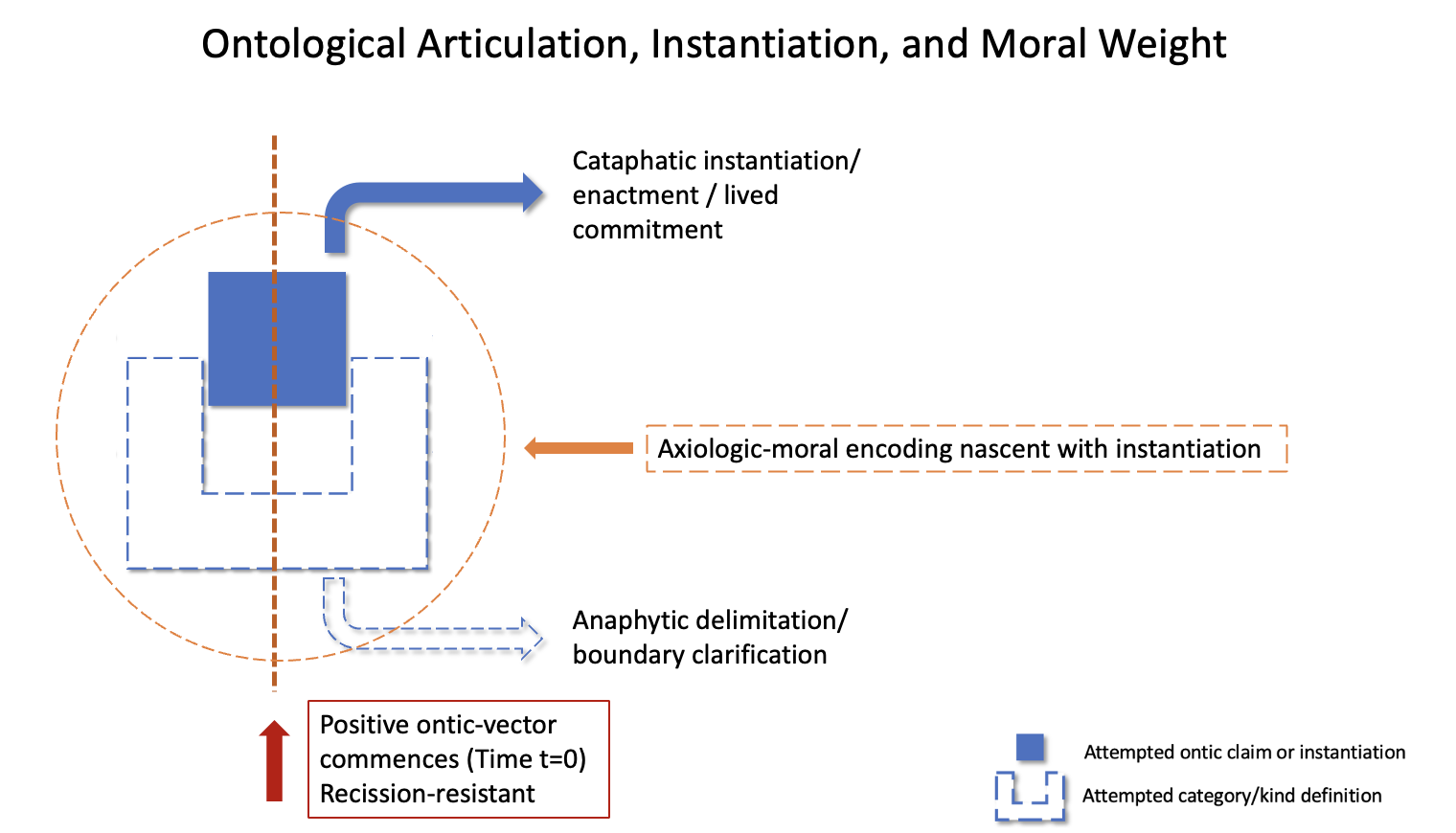
Legend
■ Solid blue block denotes positive ontic instantiation (real enactment of an ontic kind). ▢ Dashed blue block denotes a proposed or delimited category without instantiation. ┃ Red vertical line (Time t = 0) marks the commencement of instantiation, at which axiological–moral encoding is nascently infused. → Solid blue arrow (cataphatic) indicates forward enactment or lived commitment, through which exposure, consequence, and accountability unfold over time. → Dashed blue arrow (anaphatic) indicates ontological syntax and boundary clarification, applicable pre-hoc or post-hoc without enactment. ◯ Dashed orange circle denotes axiological–moral encoding, co-instantiated with the ontic vector rather than temporally subsequent. → Orange inward arrow denotes binding moral weight carried by the instantiated ontic kind.
Ontological syntax governs negative constraints on what may be coherently formed; falsifiability and accountability apply only after instantiation, where reality, time, and consequence are operative.
If ontology is irreversible, justice cannot consist in undoing what has occurred. Any conception of justice that depends upon rollback, erasure, or denial of history implicitly negates agency. Justice, in a vectoral reality, must therefore operate through irreversibility rather than against it.
Divine governance exemplifies this principle. God does not annul instantiated history in order to preserve moral order. Instead, He governs history as it unfolds—restraining excess, redirecting trajectories, adjudicating responsibility, and ordering consequences toward intelligible ends. This governance presupposes vectorality; it does not negate it.
Justice, under these conditions, is not synonymous with punishment. Nor is it identical with mere consequence. It is the ordered administration of reality under acknowledged authority. Because instantiation binds forward, justice must be prospective as well as retrospective. It addresses what has occurred, but it does so by shaping what may yet occur.
This understanding guards against two errors. The first is fatalism: the belief that irreversibility entails blind inevitability. The second is sentimental rescission: the belief that moral order requires the erasure of difficult history. Vectoral ontology rejects both. Governance is neither inert nor nostalgic; it is directive, purposive, and authoritative.
The final implication of vectoral ontology concerns rectification. If history cannot be undone without dissolving agency, then redemption cannot consist in erasure. Rectification must therefore be teleological rather than retroactive. It must heal, reorder, and resolve what has been instantiated, rather than pretending it never occurred.
This is the proper place of divine annulment—not as rewind, but as end-ward resolution. What is judged, forgiven, or redeemed is not removed from history, but integrated into a larger, governed narrative. The past remains real, but it is no longer determinative in the same way. Its meaning is transformed by authoritative resolution.
Such rectification preserves both truth and mercy. Truth, because history is not denied. Mercy, because history is not allowed to tyrannise the future. Vectoral ontology thus makes redemption intelligible: only a reality that persists can be healed; only a history that endures can be reconciled.
At this point the metaphysical structure is complete. Instantiation explains irreversibility; irreversibility necessitates vectorality; vectorality makes justice, agency, and redemption coherent without contradiction. Ontology moves forward under governance, not despite it.
This inquiry has argued that ontology, once instantiated in time, is governed by metaphysical conditions that precede and constrain all moral evaluation. Reality is not ethically generated, but ethically interpreted; covenantal order is not a consequence of moral behaviour, but its prerequisite. Ethics, therefore, does not stand over reality as a corrective abstraction—it responds to a world that already exists, persists, and binds forward.
The introduction of autonomous moral authorship constitutes the decisive ontological rupture, not because it violates a statute, but because it contests jurisdiction. From that rupture follows irreversibility, not as punishment, but as coherence. A reality that admits genuine agency cannot be endlessly retractable without dissolving responsibility itself. Vectorality, in this sense, is not an imposed constraint but the natural behaviour of instantiated being under time.
Within such a reality, justice cannot consist in rescission, nor redemption in erasure. Governance operates through direction rather than denial; rectification is end-ward rather than retroactive. History is neither sanctified nor nullified—it is governed. Moral agency thereby acquires weight without determinism, accountability without fatalism, and hope without sentimentality.
The metaphysics of ontology thus secures the intelligibility of covenant, agency, justice, and redemption by restoring their proper order of explanation. What is precedes what ought; instantiation precedes evaluation; and reality moves forward under authority, not autonomy. Only within such a structure can moral meaning endure without collapsing into abstraction or coercion.
Footnote
Justice, Consequence, and the Limits of Rescission
A crucial distinction must be maintained between the recognition of consequence and the administration of justice. The irreversibility of instantiated reality does not exhaust justice, nor does it legitimise the injustice that produced it. Rather, irreversibility constrains the mode of justice without negating its necessity.
Moral reasoning operates prospectively to guide decision-making prior to instantiation; once an act has occurred, however, justice must function retrospectively—by attributing responsibility, differentiating culpability, assigning proportionate redress where possible, and governing forward obligations. Attempts to satisfy justice through ontological rescission (i.e., undoing instantiated reality) risk compounding injustice by negating the reality of newly affected parties and dissolving agency retroactively.
Justice, therefore, does not operate by erasure but by ordered governance within consequence. This distinction explains why certain acts remain unjust even when their consequences must nevertheless be honoured, and why moral accountability persists without implying fatalism or moral acquiescence.