
This essay maps the structural destinations of moral evasion; a companion work,
here
, analyses the upstream dynamics of ontological evasion that produce such architectures.
Every civilization eventually asks the same questions: What is real? How do we know? What anchors meaning? Why do humans resist moral truth? And why, despite vast differences in religion, culture, and philosophy, do all societies exhibit the same predictable patterns of moral collapse?
Submetaphysics begins by addressing these questions at their root. The framework starts with ontology, because truth is not conceptual or procedural but ontological—something that is rather than something that is constructed. From ontology we move to epistemology, which is not the creation of truth but the posture by which the agent receives or resists truth. From epistemology we move to morality, the lived enactment of alignment or rebellion.
These three fields converge in the Axiological–Deontic–Modal (ADM) unit, the moral imprint within the person that registers the presence of truth and responds to it. The ADM is partially active in every human being. It is the internal moral architecture that can either incline toward alignment or recoil into evasion.
The decisive moment comes when the ADM is confronted: Confrontation, as in the Prodigal Son—truth meeting resistance through consequence, crisis, or exposure. Revelation, as in Lydia—truth meeting receptivity through illumination and invitation. In either case, the ADM moves from latency to decision. Truth presses in. Reality speaks. The agent stands at the fork between alignment and evasion. At this fork, the decisive question is not whether moral truth exists, but whether the self will remain exposed to it. The fault line of all moral systems is located here: whether accountability is faced directly, or whether something is permitted to stand between the self and moral reckoning. Every subsequent structure—psychological, religious, cultural, or institutional—emerges in response to this moment. Where unbuffered accountability is intolerable, evasion becomes necessary. Where accountability is faced, alignment becomes possible. What follows is not determined by information but by posture. It is here that the Submetaphysics framework must distinguish two interlocking arenas: macro and micro. Micro-Level Evasion — The Moral Core.
At the deepest level, evasion is personal. It is emotional, psychological, and volitional. It includes rationalisation, projection, pride, shame-avoidance, selective reinterpretation, and the internal recoil from exposure. This is what Scripture describes as “suppressing the truth” (Rom 1:18) and what conscience amplifies even without textual revelation (Rom 2:14–15).
Micro-evasion is always the root.It is the individual’s refusal of the relational summons of truth. Macro-Level Evasion — The Cultural Shell. Over time, societies formalize these personal evasions. They become religious systems, ethical frameworks, political ideologies, philosophical schools, and corporate cultures. These macro structures: sustain patterns of avoidance, justify inherited evasions, provide respectable pathways of escape, encourage inertia, normalize generational drift. Macro-evasion is canonized micro-evasion. It is the cultural amplification of what individuals already desire. Together, micro and macro dynamics create a feedback loop:
the individual evades → the culture adopts the evasion →the culture reinforces the evasion → the individual feels justified in avoiding truth.
This is the real mechanism of civilizational drift. Having established ontology, epistemology, morality, the ADM unit, and the dynamics of confrontation, we arrive at the central question: How exactly do human beings evade truth? What structural forms does evasion take?And why are these forms so uniform across history and culture?
The answer is architectural. All evasion—across religions, philosophies, institutions, and personal psychology—falls into nine predictable patterns. These patterns are the Architectures of Evasion: the complete set of ways responsibility can be relocated, softened, postponed, outsourced, or dissolved. They reveal the engineering of avoidance at both the personal and civilizational scale. After these nine, only one structure remains: the architecture of alignment, the non-evasive posture in which truth is received rather than managed. It is the architecture of repentance, return, relational accountability, and moral clarity. This preface therefore marks the hinge of the entire framework: Ontology establishes what is. Epistemology discloses how truth is received. Morality reveals what the agent does in response. ADM registers the confrontation. Macro and micro evasion map every possible refusal. The Architectures of Evasion now expose the full design. What follows is the structural anatomy of human avoidance—and the singular alternative that leads out of it.
Modern public discourse—academic, political, and corporate—displays a highly advanced capacity for moral evasion, reflecting the same deeper patterns that operate within individual agents. But it lacks any framework for recognising that evasion structurally.
Academics name surface phenomena:
Political theorists describe patterns:
Corporate literature identifies symptoms:
But none of these fields identify the architecture beneath the symptoms— the structural ways human beings redistribute moral responsibility in order to avoid direct moral encounter.
The result is a profound analytical gap:
The evasions are treated as behaviours, not as architectures.
Contemporary thought assumes:
But none of these assumptions can explain:
The reason is simple:
Responsibility is not primarily psychological or sociological; it is ontological. It flows from how a system conceives the nature of the agent, the nature of ultimate reality, and the structure of moral obligation.
Without this ontological clarity, modern discourse can only treat symptoms.
This section is necessary because:
This framework restores what modern discourse lost:
A structural ontology of responsibility.
It explains why:
It also explains why there can be only one non-evasive structure— and why it is the necessary corrective to political, corporate, academic, and civilizational drift.
This appendix is therefore not merely a classification, but a diagnostic instrument— a blueprint for understanding how moral truth is avoided at the deepest structural level, and how it must ultimately confront the agent and the culture. Although these failures appear primarily at the corporate or civilizational level, the underlying structure is always personal. Macro-level evasion merely stabilises and institutionalises the same manoeuvres that individuals perform at the micro-level—emotional, psychological, and volitional acts of avoiding moral exposure. The corporate, political, and academic patterns highlighted here are therefore not the root but the symptom. The deeper analysis that follows begins by returning to the micro-level, where all evasive architecture originates.
Human conduct is not shaped only by ethics, psychology, or social conditioning; it is shaped by a deeper layer of accountability architecture—the structure through which a person or a culture locates, distributes, or avoids moral responsibility. Throughout history, despite vast variation in religious doctrines, social norms, and philosophical systems, a striking anthropological constant emerges: human beings repeatedly develop ways to redirect, defer, dilute, or dissolve the burden of moral accountability.
This appendix classifies these structural patterns. It does not concern itself with comparative religion or historical criticism. Instead, it identifies the fundamental ways in which worldviews—ancient or modern, religious or secular—handle the moral weight of obligation.
Crucially, this taxonomy does not reduce any tradition or system of thought to its accountability architecture. Traditions are complex, layered, and internally diverse. What follows is not a doctrinal analysis but a structural account of how responsibility is treated within different ontological frames.
Furthermore, although these accountability architectures differ widely in sophistication, benevolence, and civilizational impact, they share one defining feature:
The differences lie in how responsibility is relocated—whether into cycles, dissolution, ritual, external law, communal identity, personal discipline, or internal psychological detours.
This appendix therefore provides not a comparative hierarchy, but a unified structural grammar of moral evasion. It frames moral systems according to where they place the final moral burden, which is an ontological and anthropological question rather than a theological or cultural one.
Every worldview provides an answer—explicit or implicit—to six diagnostic questions. These questions reveal the underlying architecture with complete reliability.
1. Where is guilt located?
Is responsibility borne by the individual, the group, fate, ritual impurity, cosmic law, or nowhere at all?
2. How is moral burden resolved?
Through ritual? Law? Self-discipline? Detachment? Cosmic process? Social identity? Internal psychological reframing?
3. Is resolution definitive or cyclical?
Does accountability culminate at a fixed moral horizon, or is it endlessly recurring?
4. Is moral transformation internal or procedural?
Does change occur in the will and conscience, or is moral status restored externally or technically?
5. Can responsibility be transferred?
Can guilt be moved to ritual, law, community, performance, abstraction, or projection?
6. Who or what issues the final moral claim?
A transcendent personal Being? An impersonal cosmos? A community? A law system? The self? No one?
These six questions allow any system—religious, philosophical, political, or psychological—to be analysed at the level of structural accountability rather than surface practices.
Evasion must be chosen before it can be expressed — and divine confrontation removes all ambiguity
Evasionpresupposes awareness. According to Romans 1:19–21, what may be known of God is manifest in every moral agent—perceived inwardly through conscience and outwardly through creation. This knowledge is not dormant (implying prior activation) but latent—structurally embedded within the ADM unit. It is this latent orientation toward the moral order that makes evasion possible: one cannot resist what one does not already apprehend. Thus every evasive architecture is a reaction, not an absence; a refusal, not a lack.
Accountability architectures do not operate independently of the agent’s will. A culture can offer an evasion, but only the moral agent can accept it. Evasion is not passive absorption; it is an act of volitional consent.
This is the anthropological constant behind all nine evasive architectures:
Every structure of evasion requires the agent to want the evasion.
The nine architectures provide the forms of evasion— but the agent supplies the desire, the assent, and the rationalisation that make those structures effective.
This is why evasion is never merely:
It is moral.
The evasion is only real because:
Thus:
Evasion is always bilateral: systems offer it; the agent arrogates it.
This volitional dimension is essential, because it establishes the true locus of responsibility.
The agent is never merely misled by culture. The agent chooses to use culture as a shield.
If evasion is volitional, then God’s moral government must address not only the structure of sin but the posture of the agent. A just God cannot allow the agent to claim:
For divine justice to be vindicated, God must:
Thus, divine theodicy requires a paradoxical balance:
God respects evasion but removes excuse.
He allows the evasion to be wanted, but He disallows it from being plausibly justified.
This is why the divine economy includes moral confrontation—the point at which truth becomes inescapably personal.
The Prodigal Son parable is not sentimental; it is architectural. It reveals the mechanics of divine theodicy:
This is the pattern:
God provides unavoidable confrontation that absolves Himself from responsibility for the agent’s evasion.
He does not override autonomy; He simply makes the cost of evasion visible and the truth unavoidable.
He honours the human choice but ensures that the choice is conscious, not concealed behind cultural structures or psychological evasions.
Divine confrontation is necessary because without it:
But with confrontation:
God’s responsibility ends and the agent’s responsibility begins.
This is the hinge of all moral judgment:
Thus, the nine architectures of evasion become morally significant only because:
This closes the theodicy loop in your system:
Divine justice is upheld because God honours freedom yet removes excuse; human responsibility is upheld because the agent’s evasion is both chosen and confronted.
Evasion occurs in two distinct arenas: the macro-level, where entire cultures develop stable patterns for displacing responsibility, and the micro-level, where individual agents execute their own granular manoeuvres of avoidance. These two levels are different not only in scale, but in structure, intention, and moral significance.
At the macro level, evasion takes the form of civilizational habits of accountability—patterns so stable that they become embedded in:
These macro-architectures act as cultural containers that channel responsibility into predictable pathways. Whether through karmic cycles, ritual purification, procedural law, collective identity, or dissolution of the self, macro-level structures create public and inherited modes of evasion.
They provide broad, structural pigeonholes into which populations can place moral responsibility without confronting it directly. But although these patterns may shape a civilization, they do not determine the agent.
The macro level explains the environment in which evasion is normalised, stabilised, and codified.
Micro-evasion, by contrast, belongs to the internal life of the individual agent. It is expressed through:
If macro evasion is structural, micro evasion is granular. If macro evasion is historical, micro evasion is immediate. If macro evasion offers categories, micro evasion performs the interpretive manoeuvre that makes the category personally useful.
Micro-level evasion is not a cultural inheritance but a moral choice—the subtle inward turn away from truth, the quiet elevation of autonomy over accountability.
Where macro provides forms, micro provides the desire that makes those forms attractive.
These two arenas of evasion are inseparable.
1. Macro requires micro
A culture can offer evasion, but only the individual agent can:
No structure—religious, legal, ritual, bureaucratic, or philosophical—can strip the individual of responsibility for the moment they choose to use it as an escape. Macro-architectures become powerful only because micro-evasions want what they provide.
Conversely, individuals rarely invent entirely new forms of evasion. They adopt whatever the culture already offers:
Micro-evasion expresses itself through macro structures because macro structures provide the pre-legitimised pathwaysthrough which internal avoidance can move.
Thus:
Macro-evasion explains how societies evade; Micro-evasion explains how individuals evade; The two reinforce each other, but they are never morally equivalent.
Macro-architectures shape external behaviour, but they do not absolve the will. Micro-evasion—personal, emotional, cognitive, volitional—is where moral responsibility resides. It is the micro-level that:
The macro-level may surround an agent, but only the micro-level can choose evasion.
This distinction protects the integrity of moral agency:
The individual remains accountable because evasion always begins as an inward maneuver before it becomes a cultural pattern.
Macro-evasion is the environment; micro-evasion is the act.
Macro-evasion is inheritance; micro-evasion is assent.
Macro-evasion is pattern; micro-evasion is posture.
Macro-evasion is collective expression; micro-evasion is personal responsibility.
Together, they explain how civilizations develop distinct moral signatures while each agent remains fully accountable for the evasions they personally embrace.
This dual structure completes the logic of the accountability architectures and prepares the ground for understanding how evasion moves from ontology and morality into semiotics, pragmatics, and the wider discursive environment.
Having established the ontological ground of truth, the epistemic posture of the agent, and the ADM unit as the internal register of moral encounter, we are now positioned to map the full architecture of human moral response. At the moment of confrontation or revelation, the agent stands before a binary choice:
Volitional Alignment or Volitional Rejection.
This binary is not psychological but ontological.Truth confronts. The will responds.Every subsequent moral pattern flows from this fundamental division.
Definition: Alignment is the acceptance of relational accountability. The agent receives truth without displacement, reframing, or delay. Responsibility is neither outsourced nor self-engineered; it is accepted as morally binding and personally addressed.
Characteristics:
humility
repentance
exposure
sincerity
ontological submission
epistemic openness
relational return
Alignment is not simply ethical behaviour; it is the restoration of the proper relationship between the agent and reality. This architecture is unique because:
It does not evade responsibility.
It does not mediate truth through technique.
It yields transformation rather than management.
Alignment is therefore the only non-evasive structure, the terminus toward which all moral confrontation is designed, and the singular counterpoint to the evasive reflex of the human will.
Rejection is the refusal of relational accountability. Unlike alignment, which is singular, rejection unfolds in three distinct movements, each representing a deeper entrenchment of the evasive will.
These movements are:
Denial
Externalisation
Internalisation
Together they constitute the complete anatomy of evasion. All nine evasive architectures sit under these three movements.
Definition:Denial is the pre-architectural, reflexive recoil from exposure. It has no metaphysics, no ritual form, no procedural framework. It is the simplest possible evasion:
“This is not about me.”
“Nothing is wrong.”
“There is no problem.”
Function: To delay recognition long enough for the will to adopt a more stable evasive strategy.
Denial is thus the seed of all later evasion. It precedes architecture but is not itself an architecture. Once denial collapses under reality or conscience, the will seeks structured forms of avoidance. These are the two major architectural families: Externalisation and Internalisation.
Responsibility is pushed outward.
Externalisation is the most ancient and widespread form of evasion. Here the agent retains the self but refuses to locate moral burden within it. The responsibility is projected into metaphysics, time, ritual, law, community, opposition, or nihilism. The externalising will says:
“The problem is not in me.”
Externalisation subdivides into seven architectures, arranged from most ontological to most existential:
Mechanism: dissolve the subject; no one exists to confront.
Mechanism: spread responsibility across cycles or cosmic recursion.
Mechanism: transfer guilt into symbolic or ceremonial action.
Mechanism: replace moral encounter with correctness and compliance.
Mechanism: embed responsibility in tribe, caste, class, or identity.
Mechanism: export guilt to an external scapegoat.
Mechanism: nullify obligation by denying meaning or value.
Responsibility is pulled inward but re-engineered.
When denial collapses and externalisation fails or becomes untenable, the will retreats inward. But this inward turn is not alignment; it is a final sophisticated evasion that retains autonomy under the guise of sincerity and effort. Internalisation says:
“I will change — but on my terms.”
Internalisation has two architectures:
Mechanism: transform responsibility into a project of self-mastery or discipline.
Mechanism: postpone obedience until an impossible internal ideal is reached.
Volitional Response → Two Paths → Three Movements → Nine Evasions → One Alignment.
This taxonomy reveals the full map of the human will under moral confrontation.Everything that follows—ontological placement (Section VI), epistemic posture (Section VII), moral consequence (Section VIII), and discursive signature (Section IX)—proceeds from this structural division.
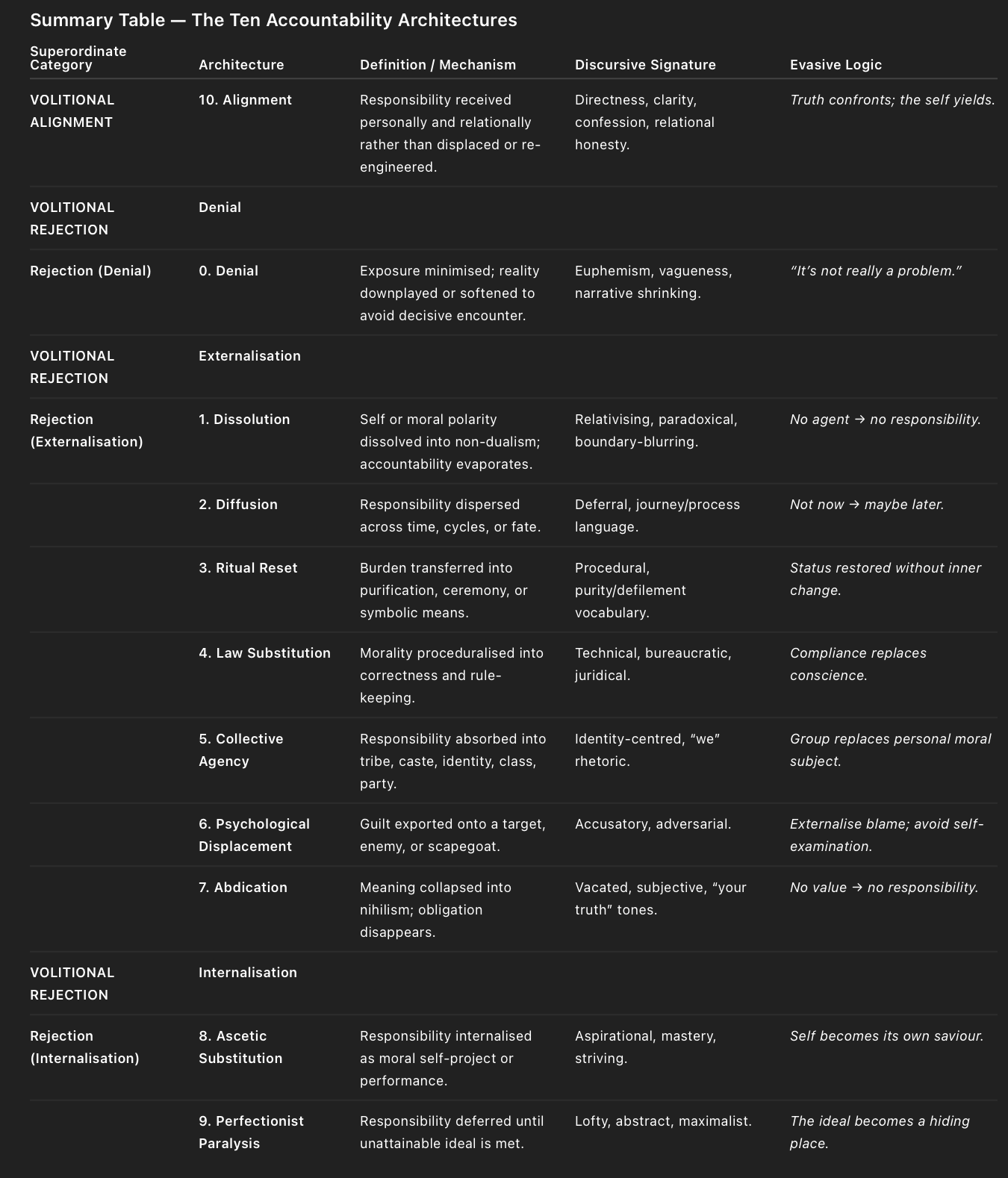
The architecture of moral evasion is not arbitrary. It flows directly from ontology—the nature of what is ultimately real. Every accountability structure presupposes and expresses a corresponding metaphysical commitment. The placement of responsibility reveals the implicit metaphysics beneath it.
Ontology does not merely influence accountability; it determines its possible configurations.
Where ultimate reality is impersonal (energy, flux, emptiness, Brahman, Tao), personal accountability becomes metaphysically incoherent.
This yields the earliest evasions:
If the self dissolves into the One, there is no agent to confront.
If time is cyclical and moral action recurs across ages, urgency dissolves into cosmic process.
Impersonal ontology cannot sustain definitive moral encounter.Thus, impersonal systems gravitate toward Dissemination and Diffusion as their natural accountability structures.
Where the ultimate order of reality is conceived as structure, rhythm, or correctness:
cosmic order → ritual reset
divine law → procedural substitution
metaphysical balance → karmic accumulation
These emerge inevitably from ontologies in which reality is formal rather than personal.If reality is order, morality becomes technique.
Where identity is defined by:
caste
tribe
nation
class
bloodline
responsibility naturally relocates into the group.
The individual becomes morally secondary to communal identity.
Where the self is the highest principle of meaning, agency, or will:
autonomy
self-governance
self-mastery
the individual becomes responsible for their own transformation without relational confrontation.
These arise from ontologies that elevate the sovereign sel
If reality is without meaning or teleology, accountability itself disintegrates.
Nihilism is not accidental; it is the architectural consequence of ontological vacuity.
Only if ultimate reality is personal, relational, authoritative, and morally purposive can the agent be confronted as a moral subject.
A personal God can:
summon
confront
judge
forgive
restore
Thus:
Personal ontology necessitates relational accountability. This is the metaphysical ground of alignment.
Alignment is therefore not one option among many; it is the only ontological configuration in which responsibility can be fully received rather than dispersed.
Ontological structure → Accountability structure.
Impersonal → Dissolution, Diffusion
Procedural → Ritual, Law
Communal → Collective
Adversarial → Projection
Vacuous → Abdication
Volitional → Ascetic, Perfectionism
Personal → Alignment
This ontological imperative guarantees that the moral architectures charted in Section V are not arbitrary behaviours but metaphysical necessities.
All epistemic posture emerges from prior latent awareness.The evasive mind does not lack truth; it refracts truth.
Because truth is ontological rather than constructed, epistemology is not primarily about cognition but about posture.What the agent does with truth depends entirely on where responsibility is located.Thus epistemology mirrors the will’s architecture:
Alignment receives truth.Rejection manages truth.
All evasive structures—Denial, Externalisation, Internalisation—produce a processed form of truth.Only Alignment allows truth to confront the agent as a summons.
Denial is the earliest epistemic distortion:it interrupts contact with truth at the moment of emergence.
Truth becomes inaudible because the agent instinctively refuses its implications.
Epistemic signature:
minimisation
deflection
selective attention
strategic inattention
Denial is not a theory of truth; it is the refusal to allow truth to register.
Each externalisation architecture produces a characteristic way of processing truth so that the self is not implicated.
If the self dissolves, truth is reinterpreted as non-dual, symbolic, or phenomenological.
Truth is reclassified as cyclical, developmental, or non-urgent.
Truth becomes a purity-status to be restored, not a moral encounter.
Truth is equated with correctness, rule alignment, or institutional compliance.
Truth is mediated through group membership, loyalty, or communal narrative.
Truth is always about the other—never the self.
Truth becomes subjective, optional, or meaningless; epistemic force collapses.
In all these cases:Truth is processed before it is allowed to confront.
Internalisation retains responsibility but converts truth into a private project, thus avoiding relational accountability.
Truth becomes something to strive toward through discipline, mastery, or technique.
Truth becomes so lofty and abstract that obedience is postponed indefinitely.
Truth is accepted conceptually but rejected functionally.
Only in alignment does truth appear in its ontological form:
direct
personal
morally implicating
unbuffered
transformative
relational
Here truth is not processed; it confronts.
This corresponds exactly to your epistemological distinction:
Evaded accountability produces processed truth.Definitive accountability produces confrontational truth.
This completes the epistemic architecture: the structure of knowing mirrors the structure of responsibility.
Moral behaviour is not downstream from ethics, norms, or law; it is downstream from the architecture of accountability.Where responsibility is placed—denied, displaced, re-engineered, or received—determines the trajectory of both individual character and cultural morality.
Thus the nine evasive architectures weaken moral life in patterned ways, while Alignment alone produces integrity and stability.
The agent refuses contact with truth. Exposure is short-circuited.
No self remains to act morally.
No decisive horizon; repentance becomes unnecessary.
Purity replaces repentance; repeatable resets replace transformation.
Correctness replaces conscience; rules displace relationship.
The agent hides in the group; morality becomes inherited rather than chosen.
Moral focus is turned outward; self-examination disappears.
Meaning erodes; moral categories weaken; commitment declines.
Performance replaces repentance; effort replaces encounter.
The ideal becomes a shield; action is postponed indefinitely.
Despite their differences, all nine evasions generate the same ultimate outcome:
They prevent the agent from standing personally under moral truth.
This is the defining signature of moral evasion.
Cultures built on evasive architectures inevitably display predictable symptoms:
oscillating moral norms
dependence on external control (ritual, law, compliance)
moral fragmentation
shame-based rather than conscience-based ethics
corruption through mediators and intermediaries
fragile reform movements that collapse under stress
Civilizations rise and fall not because ethics change but because the architecture of responsibility shifts.
Where accountability is diffused, dissolved, collectivised, or proceduralised, moral stability cannot last.
Alignment is the only structure that:
unifies inner and outer life
sustains stable conscience
binds truth and action
prevents moral drift
produces relational integrity
resists corruption
generates genuine transformation
Because responsibility is personal and relational, transformation is ontological and not merely behavioural.
Alignment is therefore the singular moral architecture capable of renewing individuals and civilizations.
Cultures do not begin with moral transgression; they begin with:
relocation of responsibility
procedural substitutes
collective guilt narratives
purity rituals
identity morality
meaning collapse
self-engineered righteousness
Moral collapse is always architectural before it is behavioural.
Reform movements fail when they:
strengthen ritual,
increase law,
intensify collective identity,
tighten disciplinary structures,
elevate personal striving,
or double down on ideological purity.
These only rearrange evasions.
Genuine moral renewal requires Alignment—the restoration of responsibility to the agent in relational encounter with truth.
Language is never morally neutral.Every accountability architecture produces a corresponding discursive posture—a way of speaking, framing, inferring, justifying, or avoiding.Speech reveals the architecture beneath it.
Thus discourse does not merely describe reality; it discloses where responsibility has been placed.
The ten architectures can be identified by their linguistic signatures.
Denial produces:
vague generalities
euphemism
avoidance of specifics
downplaying
narrative softening
Discursive signature:diversion, minimisation, and rhetorical shrinking of exposure.
Each externalisation architecture generates a predictable rhetorical mode.
Truth becomes paradox, symbol, or phenomenology.Boundaries blur; contradictions cease to matter.
Frames emphasise journey, process, recursion, and the “long arc.”Truth becomes non-urgent, indefinitely postponed.
Language focuses on purity, status, ritual failure, and ceremonial restoration.The tone revolves around technical compliance or symbolic repair.
Speech becomes technical, rule-heavy, bureaucratic.Correctness replaces conscience; legality replaces moral clarity.
Narratives centre on we, not I:group virtue, inherited guilt, communal belonging, ideological loyalty.
Tone becomes adversarial, outward-facing, reactive.Rhetoric majors on the faults of others rather than self-examination.
Truth dissolves into subjectivity or preference.Obligation evaporates into “personal choice,” “your truth,” or “none of this matters.”
In each case:Language is used to stabilise the distance between truth and the self.
Internalisation retains responsibility but reframes it linguistically.
Tone emphasises striving, rigor, discipline, moral maximalism.The rhetoric of trying replaces the rhetoric of surrender.
Language becomes lofty, abstract, grand, and impractical.The ideal is spoken; the action is deferred.
Both discourses sound serious but produce no alignment.
Only Alignment enables truth-speaking rather than truth-managing.
Discursive signature:
clarity
simplicity
directness
relational honesty
absence of euphemism
confession rather than concealment
moral precision without harshness
truth spoken as encounter, not technique
Here language no longer manages the moral field; it submits to it.
Where evasion produces rhetoric shaped by escape,alignment produces rhetoric shaped by truth.
Across all cultures, religions, philosophies, ideologies, and psychological patterns, human beings evade moral encounter in only a limited number of ways.Once the ADM unit is activated and the will is confronted, the agent chooses between two possible postures:
Volitional Alignment or Volitional Rejection.
Rejection, in turn, unfolds in three movements:
Denial — the primitive reflex
Externalisation — responsibility pushed outward
Internalisation — responsibility pulled inward but distorted
These generate the nine evasive architectures, which exhaust the possible strategies by which the agent can avoid standing personally under truth:
Dissolution
Diffusion
Ritual Reset
Law Substitution
Collective Agency
Psychological Displacement
Abdication
Ascetic Substitution
Perfectionist Paralysis
These are not cultural curiosities, nor merely psychological behaviours, nor surface-level sociological patterns. They are ontological necessities given the nature of the agent, the nature of responsibility, and the nature of truth.
Civilizations embody these structures; individuals internalise them. Macro-evasion institutionalises what micro-evasion desires.Cultures drift because hearts drift; institutions evade because persons evade.
This taxonomy exposes the underlying grammar:
Externalisation disperses;Internalisation re-engineers;Alignment restores.
The first nine describe humanity as it is—instinctively evasive, architecturally consistent, and volitionally resistant to exposure.
The tenth describes humanity as it must become—capable of truth, capable of responsibility, capable of relational return.
Alignment is not a category among others but the negation of evasive structure itself, the only posture in which:
truth is not processed but received,
responsibility is not displaced but embraced,
and transformation is not procedural but ontological.
Thus the entire Submetaphysics framework culminates in this architecture:
Ontology → establishes the ground of reality
Epistemology → reveals the posture toward truth
Morality → expresses response through responsibility
Accountability Architecture → maps the will’s structural choices
And in this final contrast—between evasion and encounter—the moral agent stands exposed before truth,and the possibility of restoration becomes clear.